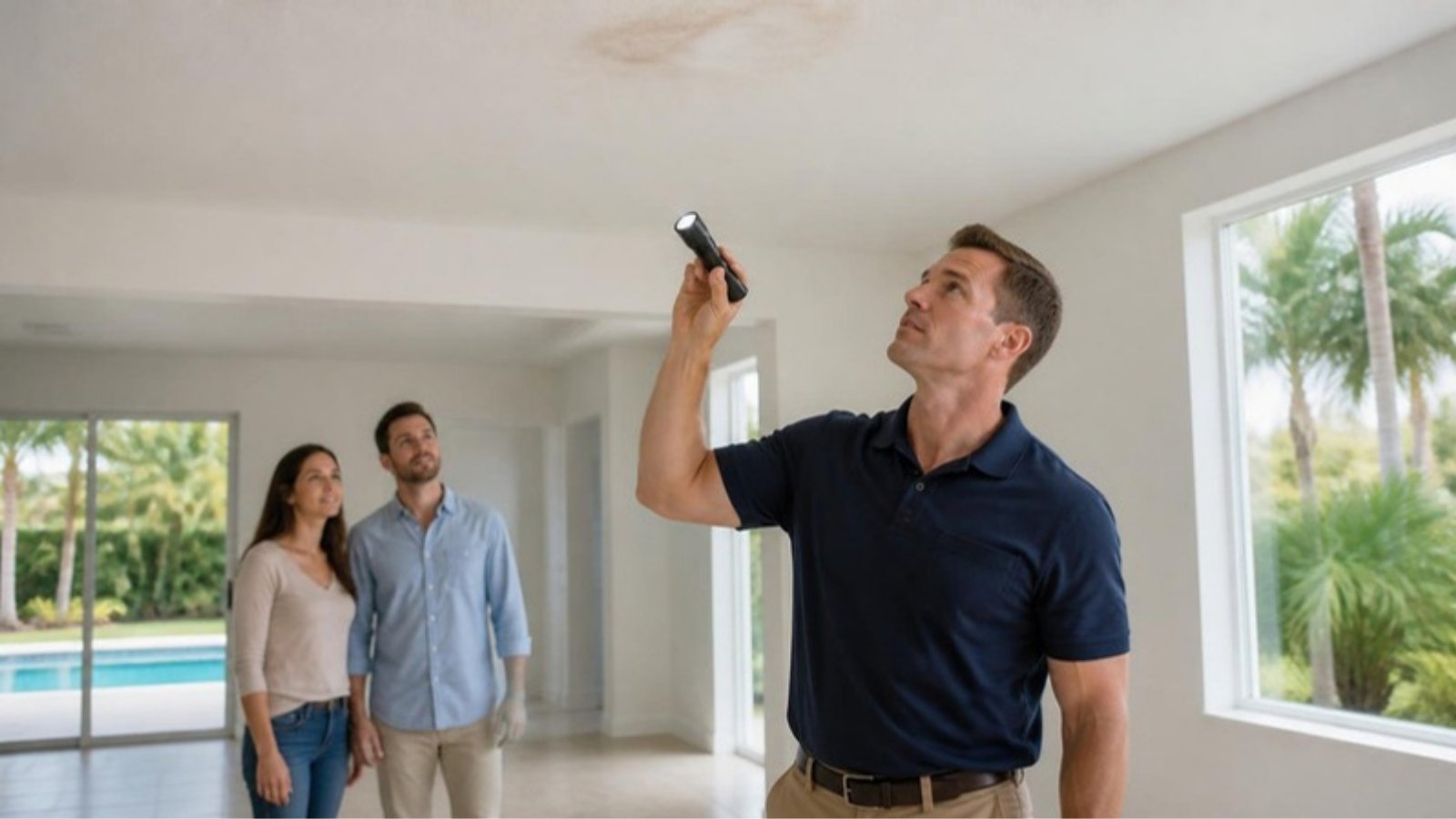
The hall bathroom in a Delray Beach townhouse looks fine from the doorway. The tile is clean, the glass door shines, and the grout got scrubbed last weekend. Then someone notices paint bubbling at the baseboard in the bedroom on the other side of the wall, or a brown ring spreading across the living room ceiling right under the upstairs shower.
A shower leak behind tile rarely shows up inside the shower. It shows up next door, downstairs, or as a musty smell nobody can trace. This article explains where these leaks start, the signs that water is getting behind the tile, why bleach on the grout does not solve it, and what it takes to find the source, remove the damage, and dry the wall.
How water gets behind shower tile
Tile looks waterproof, but in most showers it is not the part keeping water out of the wall. Grout is porous, and water soaks into it every time someone showers. What protects the framing is the waterproofing layer underneath, plus the caulk and seals at the joints. When any of those fail, water gets in and stays in.
A failed shower pan
In a tiled shower floor, the tile sits on a mortar bed, and under that is a waterproof liner or membrane that slopes toward the drain. Water that seeps through the grout is supposed to hit the liner and run out through small weep holes in the drain body. If the liner is torn, was punctured by a fastener during installation, or does not run high enough up the walls and curb, water escapes into the subfloor and the bottom of the walls. Weep holes clogged with mortar or soap residue cause a slower version of the same problem: the mortar bed stays saturated and the floor grout never dries.
Cracked grout and failed caulk
Grout cracks as a house settles and tile shifts. Caulk at the inside corners, along the curb or tub edge, around the valve trim, and around a recessed niche shrinks and pulls away over time. Each gap lets water reach the backer board. Some older bathrooms have tile set over standard or moisture-resistant drywall instead of cement board, and that drywall breaks down quickly once it stays wet.
Valve, cartridge, and supply leaks inside the wall
The shower valve, the supply pipes feeding it, and the pipe running up to the shower head all sit inside the wall. A leaking valve body, a worn cartridge seal, a loose fitting at the shower arm, or a pinhole in a supply pipe can drip into the cavity without ever showing up in the shower. Supply-side leaks are under pressure, so some drip constantly. Leaks on the shower head side often drip only while the water is running.
Signs of a shower leak behind tile
The signs are often in a different room from the shower. Look for:
- Loose or hollow-sounding tiles. Tap gently with a knuckle. A dull, hollow sound, or a tile that moves, means the bond behind it has failed, often because of moisture.
- Grout that darkens and never dries. Grout darkens when wet and should lighten as the bathroom dries out. Grout that stays dark for days, especially low on the wall, is sitting on wet material.
- Caulk that keeps growing mildew no matter how often it is cleaned or replaced.
- Stains or peeling paint on the other side of the wall, usually at the baseboard in a bedroom, closet, or hallway.
- A swollen door casing or baseboard near the bathroom doorway, or a door that suddenly sticks.
- A ceiling stain below an upstairs shower, or, in a condo, in the unit below yours.
- A musty smell that lingers after the exhaust fan has run and the room is dry.
No single sign proves a leak, but two or three together are worth investigating. If the stain is in a neighbor’s ceiling, our guide to coordinating condo water damage in South Florida explains how owners and associations usually sort out who handles what.
Why bleach on the grout does not fix it
The usual first response to dark grout is bleach. The spots fade, and two weeks later they are back, for three reasons:
- The moisture is still there. Bleach does nothing to stop water getting behind the tile, and as long as the wall stays wet, the growth returns.
- The surface is not where the problem is. The growth on the grout is often a small part of what is on the back of the drywall, the framing, or the backer board.
- Killing mold is not the same as removing it. The EPA does not recommend biocides such as chlorine bleach as a routine part of mold cleanup, and it notes that dead mold can still cause allergic reactions in some people. The goal is to remove the growth and fix the moisture.
If you do clean with bleach, never mix it with ammonia or other cleaning products. Cleaning visible spots is fine as routine upkeep, but it is not a repair. Our article on why mold keeps coming back after water damage explains the pattern.
Finding the source: what a plumber checks
Before anyone opens a wall, a licensed plumber should confirm the source. The tests are usually straightforward:
- Meter check. With every fixture off, the plumber watches the water meter. If it moves, there is a leak somewhere on the pressurized supply side.
- Running the shower head alone. Water that appears only when the shower head runs points to the shower arm, the riser pipe, or spray getting past the door.
- Flood test of the pan. The drain is plugged and the shower floor is filled for a set period. A drop in the level, or water showing up outside or below the shower, points to the pan or liner.
- Looking through the access panel. Many showers have a removable panel on the other side of the valve wall, often inside a closet, where the valve and fittings can be seen directly.
Our side of the job is figuring out how far the water traveled, using moisture meters and thermal imaging, so the plumber’s repair and our remediation cover the same area.
Why tile and drywall sometimes have to come off
Nobody wants to tear out a tile wall, and sometimes it is not necessary. A failed caulk joint caught early may only need new caulk and a few follow-up moisture readings. When water has been getting behind the tile for months, though, removal is usually the only lasting fix.
- Wet walls cannot dry through tile. Tile, thinset, and backer board slow evaporation to a crawl, so a sealed wall cavity can stay wet for a long time even with drying equipment in the room.
- Mold grows on the hidden side. Drywall paper, wood studs, and the bottom plate are exactly what mold feeds on, and they are all behind the tile.
- The waterproofing has to be rebuilt anyway. If the pan liner or wall membrane failed, the tile on top of it has to come off for the repair.
- Porous materials with growth are removed, not cleaned. Moldy drywall, insulation, and backer board are bagged and removed. Sound framing can usually be cleaned and dried in place.
Removal stops at the moisture boundary, the point where readings show the material is dry, which keeps the opening only as large as the damage requires.
How Edwards Property Remediation handles a shower leak with mold
When a shower leak has turned into a mold problem, our IICRC-certified technicians work through the same core steps:
- Inspection and moisture mapping. We map the wet areas and photograph conditions before work starts. If there is a musty odor with no visible source, or you need a documented baseline, mold testing can help define the scope.
- Containment. The work area is sealed with plastic sheeting and kept under negative air pressure so spores do not drift into the rest of the house, and HVAC vents in the area are covered. If the home is occupied, we plan around the rooms you still need, as described in our article on planning mold remediation around occupied rooms.
- Removal. Moldy and water-damaged materials are removed to the moisture boundary and bagged inside the containment.
- Cleaning. The remaining framing and surfaces are HEPA-vacuumed and cleaned as part of our mold remediation process.
- Drying. Dehumidifiers and air movers bring the framing and subfloor down to dry readings before anything is closed up, using the same advanced structural drying we apply after larger water losses.
- Documentation. Photos, moisture readings, and a written scope go into a file you can share with your insurer, your contractors, and, for condo owners, the association.
Once the area is clean and dry, your plumber or tile contractor rebuilds the waterproofing and sets new tile. Closing up a wall before it is dry is how a new shower ends up with the same problem a year later.
Keeping a repaired shower dry
- Run the exhaust fan during every shower and afterward until the mirror clears.
- Squeegee the walls and glass so less water sits on the grout.
- Check the caulk every few months at the corners, curb, valve trim, and niche, and replace it when it cracks or pulls away.
- Keep the drain clear so water does not pond on the shower floor.
- Keep indoor humidity under control. The EPA recommends keeping indoor relative humidity below 60%, ideally between 30% and 50%. In South Florida that usually means running the AC and leaving the bathroom door open after showers.
Frequently asked questions
How do I know if my shower is leaking behind the tile?
Look for grout that stays dark long after showering, tiles that sound hollow or move, peeling paint or stains on the other side of the wall, a ceiling stain below an upstairs shower, and a musty smell that will not clear. A plumber can confirm the source with a meter check, a flood test of the pan, and a look through the access panel.
Can a leaking shower be fixed without removing the tile?
Sometimes. If the problem is failed caulk or a small grout crack caught early, regrouting or recaulking may be enough, as long as moisture readings show the wall behind it is drying. If the pan liner has failed or there is mold on the back of the wall, the tile and backer usually have to come off.
Is the black stuff in my shower grout mold?
Often it is mold or mildew growing on soap residue at the surface, which routine cleaning can handle. When it comes back quickly after cleaning, stays damp, or shows up with loose tiles or a musty smell, it can point to moisture behind the tile.
Is mold behind shower tile a health risk?
Mold affects people differently, and people with asthma, allergies, or weakened immune systems tend to be more sensitive to it. If anyone in the home has symptoms you think may be related to mold, see a doctor. Either way, hidden growth should be removed and the moisture source fixed.
Who fixes a shower leak, the plumber or the remediation company?
Usually both. A licensed plumber finds and repairs the leak, a tile contractor rebuilds the waterproofing and tile, and a remediation company removes the mold and dries the structure in between. The wall should be clean and dry before it is closed up again.
Seeing signs of a hidden shower leak?
Edwards Property Remediation handles mold remediation and water damage for homes, condos, and rentals across Palm Beach County, including Delray Beach, Boca Raton, Boynton Beach, Jupiter, and West Palm Beach. Call (754) 221-6945, email info@eprllc.net, or book an appointment online.