
Job documentation
Insurance-ready water damage documentation
What a complete water damage job file contains: photographs, cause, moisture readings, drying logs and a written scope, and why adjusters ask for each.
- Mold Remediator MRSR2591
- Mold Assessor MRSA3666
- IICRC Certified Firm
Quick answer
A complete water damage job file contains dated photographs, a description of the cause, moisture readings for each affected material, drying logs and a written scope of the work. Adjusters ask for these because they show what was damaged, why each step was needed and when the building was dry. Edwards Property Remediation in Boca Raton documents its jobs with photographs, moisture readings and a written scope; coverage depends on your policy.
What a complete job file contains
A water job produces a set of records. Each one answers a question someone will ask later.
| Record | What it shows |
|---|---|
| Loss summary | Date found, source of the water, what stopped it |
| Photographs | Conditions before, during and after the work, room by room |
| Moisture map | Which materials were wet, and where, on the first visit |
| Moisture readings by date | How each material dried, and when it reached a dry level |
| Equipment log | What drying equipment was placed, where, and for how long |
| Written scope | The work done: extraction, removal, drying, cleaning |
| Removal record | What was taken out, how much, and why it could not be saved |
Together these let a person who never saw the building follow the job from the first day to the last.
Photographs that do the job
Photographs are the part of the file people look at first, so they need to be clear about where and when they were taken.
- The source. The failed supply line, the roof opening, the overflowed drain pan.
- Wide shots of each room as found, before anything is moved.
- Close-ups of damage: water lines on walls, swollen baseboards, stained ceilings, lifted flooring.
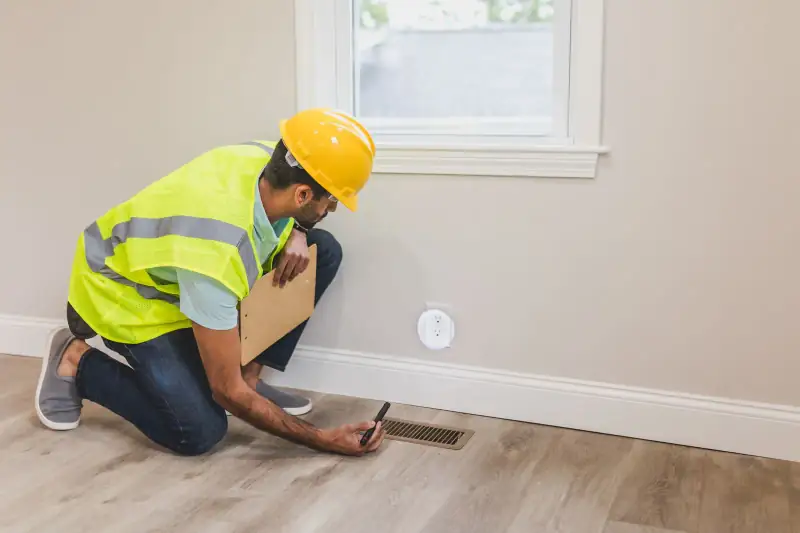
- Meter readings in place. A photo of the moisture meter on the wall ties the number to the location.
- Materials before removal, and the open cavity afterward.
- Equipment in position on the day it is set.
- Final conditions when drying is complete.
Each photo should carry a date and be labeled by room. Owners can help by taking their own pictures before anyone arrives. Those earliest images, taken minutes after the water was found, are often the most useful ones in the claim.
Moisture readings and drying logs
Readings are what turn a drying job from an opinion into a record. The IICRC S500 standard for water damage restoration is built around measuring and monitoring.
The first visit sets the baseline: readings on walls, floors, ceilings and cabinets in the affected rooms, plus a reading from the same kind of material in a dry part of the building. That dry reading is the target. On each monitoring visit the same points are measured again, along with the temperature and humidity in the room, and the numbers are logged by date.
The log shows two things an adjuster needs. It shows the equipment was necessary, because the materials were measurably wet. And it shows when the equipment was no longer necessary, because the readings reached the target. Without readings, the number of drying days is only a claim.
The written scope
The scope is the plain-language description of the work. A useful one is specific enough that two people reading it would picture the same job.
- The rooms affected, with approximate dimensions.
- The category of water and the reason for that call.
- Extraction: where, and from what surfaces.
- Removal: which materials, how many linear or square feet, and why they could not be dried.
- Drying: the equipment placed in each room.
- Cleaning and any disinfection performed.
- What was not included, such as plumbing repair or reconstruction.
Exclusions matter as much as inclusions. They tell the adjuster and the rebuild contractor where the restoration work stopped. Edwards Property Remediation provides a written scope with its jobs. Our water damage restoration page lists the steps a scope normally follows.
Why adjusters ask for it
An adjuster usually sees the property after the emergency work has started, and sometimes after it is finished. The wet pad is gone and the walls are open. The file is the only way to see what the building looked like on day one.
In general terms, an adjuster is checking three things.
- Cause. Did the water come from something the policy covers, and was it sudden or long-running?
- Extent. Which rooms and materials were actually affected?
- Necessity. Was each removal and each day of equipment needed?
Photographs and the loss summary speak to cause. The moisture map speaks to extent. The dated readings and equipment log speak to necessity. When one of those is missing, the adjuster has to ask, estimate or decline that part, and the claim slows down. More on how claims generally work is in our guide to water damage insurance claims in Florida.
What the owner should keep
The restoration file covers the work. A few records can only come from the owner.
- Your own photographs and video from the moment you found the water.
- A short written note of the date, the time and what you saw.
- The plumber's or roofer's invoice, and the failed part if there is one.
- A list of damaged belongings, with photos.
- Receipts for emergency expenses.
- The claim number, and the name and date of each conversation with your insurer.
Keep everything in one folder, paper or digital, sorted by date.
One limit should be stated plainly. Good documentation makes a claim easier to review. It does not decide the claim. Whether a loss is covered, and for how much, is set by your policy and decided by your insurer. We document the job so you have a clear record; coverage depends on your policy.
Related
Keep reading
Questions
Questions and answers
Something else? Call (754) 221-6945.
What documentation do I need for a water damage insurance claim?
The useful records are dated photographs of the source and of each affected room, a note of when and how the damage was found, moisture readings by date, an equipment log, a written scope of the work and a list of damaged contents. Add the plumber's or roofer's invoice and receipts for emergency expenses.
What is a moisture map?
A moisture map is a record, usually a simple floor plan or table, showing which walls, floors and ceilings were wet at the start of a water job and the reading at each point. It defines the affected area. Later readings at the same points show how the materials dried and when they reached a normal level.
Why does my insurance adjuster want drying logs?
Drying logs show that the equipment was needed and for how long. They list the moisture readings, temperature and humidity on each visit and the equipment in place. Because the adjuster often arrives after work has begun, the log is the evidence that materials were wet and that drying ended when readings reached a dry level.
Does Edwards Property Remediation document water damage jobs?
Yes. Edwards Property Remediation documents its jobs with photographs, moisture readings and a written scope, so the owner has a clear record of what was found and what was done. You can pass that record to your adjuster. We do not decide coverage. Coverage depends on your policy.
Does good documentation mean my claim will be paid?
No. Documentation shows what happened and what work was done. Whether the loss is covered is decided by your insurer under the terms of your policy, including its exclusions and limits. A clear file removes questions about cause, extent and necessity, which helps a claim get reviewed on its facts.
Can water damage be documented after it has already dried?
Partly. Current conditions can be photographed and measured, and stains, swelling and damaged materials are still evidence. What cannot be recreated is the starting moisture level and the drying record, which is why photographs and readings at the beginning of the job matter. Your own early photos help fill that gap.
Request service
Tell us what happened
Call if water is still moving or the building is not safe. For everything else, send the details and the office will get back to you.
- Florida-licensed mold remediator and mold assessor
- IICRC Certified Firm for water damage and structural drying
- Photographs, moisture readings and a written scope on every job
Open 24 hours · 980 N Federal Highway, Suite 110, Boca Raton, FL 33432
Request service
Goes straight to the EPR office in Boca Raton.