
Quick Answer
Protect people first, control or assign the source, document conditions, and avoid actions that spread water, dust, soot, mold, or chemicals. The final plan should be based on material condition, contamination, access, measurements, and a clear completion standard—not appearance alone.
Key Takeaways
- Safety and source control come before cosmetic cleanup.
- Document the original condition and every major scope change.
- Hidden layers and building systems can remain affected after surfaces look normal.
- Use material-specific methods, product labels, and measured completion criteria.
- Seek professional assessment for extensive, contaminated, recurring, hidden, or hazardous conditions.
South Florida AC Condensation Tips to Prevent Ceiling and Closet Damage should account for the property type and how it is operated. A condominium, single-family home, rental, commercial space, or vacant seasonal property can require different access, notification, drying, and prevention steps. The most useful way to think about the issue is to separate the source, the affected materials, and the evidence needed to confirm completion.
Understanding South Florida AC Condensation Tips to Prevent Ceiling and Closet Damage
South Florida property protection requires attention to water entry, humidity, air-conditioning condensation, storm exposure, roof and window maintenance, and the long periods when seasonal or rental properties may be unoccupied. Small moisture problems can remain hidden behind finishes until odor or damage appears. For South Florida AC condensation damage, apply those principles to the actual source, material condition, building layout, and evidence available at the property.
Closets can develop mold because of limited airflow, exterior-wall temperature, overpacked contents, damp shoes or textiles, roof or plumbing leaks, and nearby air-handler condensation. Remove clean contents for inspection, but avoid shaking suspect fabrics through the home. Check walls, baseboards, shelving, ceiling, and the room on the other side.
AC condensation problems can come from clogged drains, cracked pans, failed overflow switches, uninsulated lines, low airflow, dirty coils, duct leakage, or cold surfaces exposed to humid air. Ceiling and closet damage may be intermittent and tied to cooling cycles. An HVAC contractor should correct the mechanical cause while restoration evaluates wet materials.
Apply the tips that match the source and material; avoid combining advice from unrelated loss types. Small improvements in detection, documentation, and moisture control can prevent a limited event from becoming a larger repair. For South Florida AC condensation damage, apply the guidance to the actual source, material condition, building layout, and occupants rather than treating it as a generic restoration formula.
For project-specific help with South Florida AC condensation damage, review EPR’s water damage restoration information. A site assessment can connect the visible condition to the source, material condition, and safe restoration sequence.
Immediate Priorities and Stop Conditions
Build a practical routine around inspection and rapid response: know shutoffs, maintain HVAC and condensate drainage, inspect roof and exterior openings, keep indoor humidity controlled, document the property before storm season, and arrange a trusted local contact for vacant periods. Do not add activity simply to look busy; every step should have a safety, documentation, or restoration purpose.
Stop and keep the area restricted when any of the following is present:
- Wind-driven rain.
- Ac condensate overflow.
- High indoor humidity.
- Shared plumbing or roofing.
- Delayed discovery in vacant properties.
A restoration schedule never overrides safety. Use emergency services for urgent threats and qualified trades for source or system failures before normal cleanup resumes.
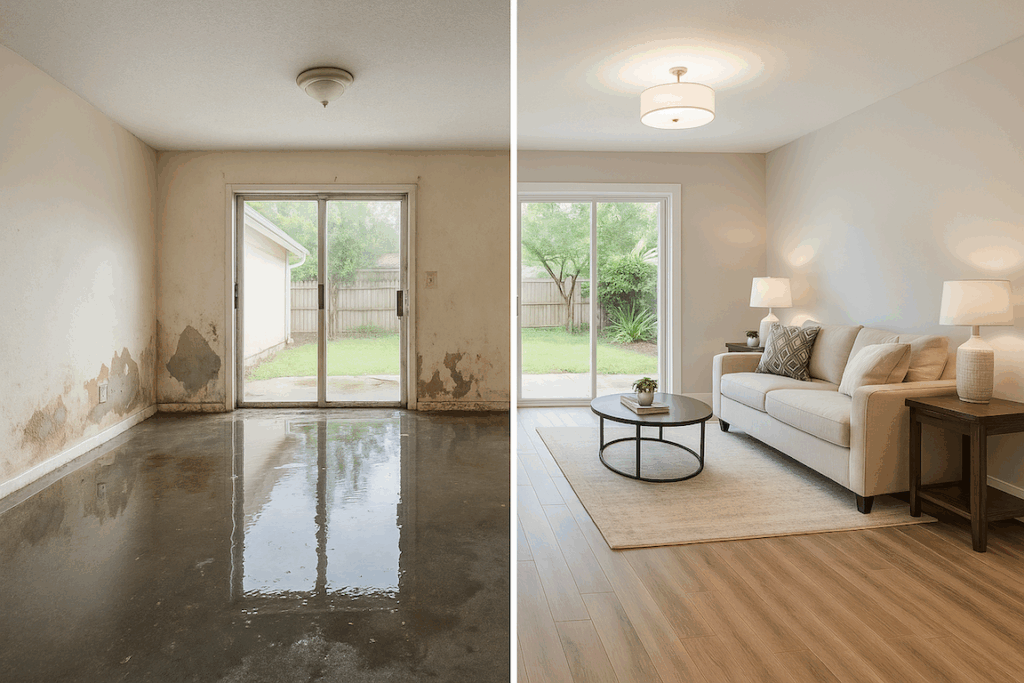
A Step-by-Step Response Plan
- Inspect water-entry points. Review roof penetrations, flashing, windows, doors, exterior sealants, balconies, drains, and the ceiling below mechanical or plumbing equipment. Look for staining, bubbling paint, soft trim, corrosion, or recurring repairs.
- Maintain the HVAC moisture-control system. Replace filters, keep return paths open, service the air handler, verify the condensate drain and overflow protection, and avoid shutting cooling off completely in a humid vacant property. Temperature alone does not describe humidity control.
- Improve airflow without spreading contamination. After the area is cleaned and dry, leave reasonable space around contents, keep supply and return paths open, and monitor humidity. During active mold conditions, do not point a fan from the closet into the bedroom.
- Prepare for storms and absences. Photograph rooms and contents, clear drainage, secure outdoor items, confirm insurance and association contacts, set leak alerts, and arrange an inspection after severe weather. Do not enter a damaged property until hazards are addressed.
- Respond to small clues early. A musty closet, ceiling ring, warped baseboard, sweating vent, or recurring window condensation deserves investigation. Cleaning the cosmetic symptom without tracing moisture can allow hidden damage to expand.
- Coordinate shared-property responsibilities. In condos, rentals, and HOAs, notify the appropriate manager or owner promptly and document the communication. Source repair, access, mitigation, and finish restoration may fall to different parties, but delay can affect everyone.
- Inspect the full condensate path. Review the coil, pan, drain, trap, float switches, line insulation, termination point, nearby ceiling, platform, closet walls, and rooms below. A cleared drain does not dry materials that were already wet.
The first scope is a working plan, not a promise that hidden conditions will match the visible damage. Update the record whenever access or measurements change the affected boundary.
Do’s, Don’ts, and Common Mistakes
Do
- Preserve photographs, readings, damaged parts, and a timeline when it is safe to do so.
- Correct or isolate the source through the appropriate qualified trade.
- Protect unaffected rooms, contents, HVAC pathways, and occupants while work is underway.
- Use product labels, equipment instructions, and material-specific guidance instead of improvised mixtures or settings.
- Set clear criteria for drying, cleaning, verification, and reconstruction before closing the file.
Don’t
- Turning off air-conditioning entirely in a closed, humid property without a moisture-control plan.
- Assuming a dry exterior after a storm means wall and ceiling cavities are dry.
- Cleaning a stain repeatedly without repairing the roof, plumbing, window, or condensate source.
- Waiting for an absentee owner or association contact list after an emergency has already started.
- Opening windows during humid weather and expecting that alone to dry wet building materials.
- Using fragrance or moisture absorbers while leaving a leak or cold exterior wall uninvestigated.
Conditions at the property control whenever they conflict with a general checklist. Contaminated water, fire residue, active mold, unstable materials, damaged utilities, or sensitive occupants justify a more conservative response.
How a Professional Evaluation Adds Value
A local moisture or restoration assessment should connect the visible symptom to the building system involved. That may require coordination among a restoration company, plumber, roofer, HVAC contractor, association, property manager, or building engineer. The correct trade fixes the source; restoration addresses affected materials. For South Florida AC condensation damage, the provider should connect each recommended action to an observed condition or documented project criterion.
A sound scope answers who does what, where, why, with which method, for how long, and under what completion standard. It also states what is not included.
Qualified review is prudent when the problem returns, the visible area does not explain the symptom, or the work could affect clean rooms, occupants, or shared building systems. Contact Edwards Property Remediation for a South Florida assessment when the work exceeds a safe, limited owner response.
South Florida and Building-Specific Considerations
Across South Florida, high humidity and air-conditioning make moisture control a year-round building operation. Storm preparation, condensate maintenance, leak detection, and prompt drying are central to prevention. These conditions should be considered when planning a response to South Florida AC condensation damage.
For South Florida, build the response around the property type, occupancy, association or management requirements, source location, and weather at the time of discovery. Avoid generic city-level assumptions; two buildings on the same street can require different access and drying strategies.
A room can feel cool while materials remain wet. Track humidity and material moisture separately, and do not treat an open window as a substitute for controlled drying.
Prevention and a Better Next-Step Record
Use a written seasonal checklist, photograph vulnerable areas, replace worn supply lines, clean condensate drains, inspect ceilings and closets, test leak sensors, trim vegetation away from drainage paths, and confirm emergency contacts before travel or storm alerts. Tie each preventive task back to the specific source or weak point identified while addressing South Florida AC condensation damage.
Closeout should include photographs, readings, source-repair proof, scope changes, products, equipment logs, disposal records, invoices, warranties, and the next inspection date.
Before closing a file involving South Florida AC condensation damage, confirm that the source is corrected, affected materials are dry and clean to the project criteria, hidden areas have been addressed, temporary controls are removed, permanent repairs are complete, and occupants or managers know what to monitor. If any answer is uncertain, keep the issue open.
Trusted References and Editorial Boundaries
This tips about South Florida AC condensation damage follows safety-first principles from public guidance and is written for property decision-making. It does not diagnose health conditions, determine legal responsibility, guarantee insurance coverage, or replace an on-site inspection.
Questions to Ask Before Work Begins
For South Florida AC condensation damage, use the following points to keep the project transparent and reviewable. Written answers are more useful than informal assumptions, especially when several parties are involved.
- What evidence supports the affected boundary?
- Has the source been stopped or assigned to the correct trade?
- Which materials are expected to remain, be cleaned, be dried, or be removed?
- How will readings, products, equipment, and scope changes be documented?
- What must be verified before containment, equipment, or temporary protection is removed?
- Who will communicate with occupants, management, and the insurer, and how often?
Store the answers with the property file for South Florida AC condensation damage and update them when the source, scope, or schedule changes. This reduces repeated site visits and conflicting instructions.
Frequently Asked Questions
What should I do first?
Keep people away from hazards, identify whether the area is safe to enter, and stop or assign the source when that can be done safely. Photograph conditions before cleanup, then choose actions based on contamination, materials, and access.
Can a property owner handle this without professional help?
A limited owner response may be reasonable only when the source is corrected, the area is small and safely accessible, contamination is not present, and all affected materials can be cleaned and dried. Stop if the area expands, utilities are involved, or hidden damage is suspected.
How long can evaluation, cleanup, or drying take?
There is no reliable fixed duration. The timeline depends on source repair, extent, material layers, contamination, access, drying or cleaning response, inspections, and reconstruction. Ask for measurable milestones and written updates rather than a guaranteed number of days.
What should I document before work begins?
Take wide and detailed photos, record discovery time and suspected source, list rooms and contents, save communications and receipts, and keep logs of readings, equipment, products, removals, and repairs. Follow insurer and safety instructions about preserving damaged parts.
When should I call a restoration professional?
Call when the source is unknown or active, the damage is extensive or hidden, water may be contaminated, mold or fire residue is present, HVAC or electrical systems are involved, occupants are vulnerable, or you cannot verify that materials are clean and dry.
Does this resource determine insurance coverage or health risk?
No. Coverage depends on the policy and claim facts, and health concerns require a qualified medical professional. This resource provides general property guidance and should be reviewed against on-site conditions and local requirements.
When Professional Help Makes Sense
If the property has extensive damage, contaminated water, electrical hazards, persistent moisture, widespread mold, or fire residue, avoid disturbing the area and arrange a professional assessment. Learn about EPR’s Water Damage Restoration service or contact Edwards Property Remediation at (754) 221-6945.
This educational resource is not medical, legal, or insurance advice. Follow emergency instructions from local authorities and qualified professionals.